The Cairngorms Up-Close: Gallery
[CAIRNGORMS UP-CLOSE] [DEEPGREEN.EARTH]
Category: TRUE FLIES
Snouted duckfly (Anasimyia lineata)

Where and when encountered: Milton Loch on 1 June 2024
About: Hoverflies of the species Anasimyia lineata may be encountered around thickly vegetated damp areas with plants such as irises and willowherbs. They are fairly widespread in England and Wales but much more sporadically distributed in Scotland.
Years with at least one adult record: 2024 (1)
Gossamer hoverfly (Baccha elongata)

Where and when encountered: Nethy Bridge on 23 August 2025
About: Hoverflies of the species Baccha elongata are typically found in shady habitats, especially those with lush vegetation. Adults visit a range of flowers including bramble and selfheal. They are widespread across Great Britain but less commonly encountered to the north than to the south of Hadrian's Wall.
Date range for live (non-diapausing) adult records: 10 May to 24 September (138 days)
Years with at least one adult record: 2025, 2026 (2)
♀ Lesser variable Bibio (Bibio lanigerus)
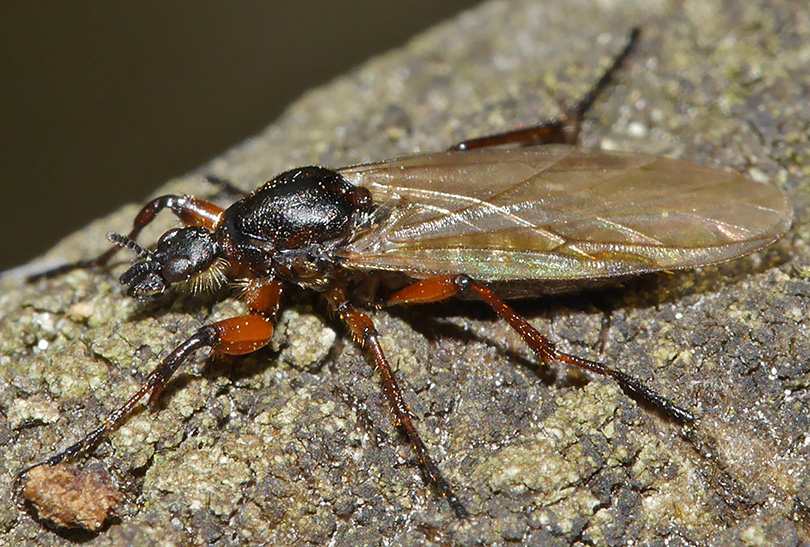
Where and when encountered: Grantown-on-Spey on 5 May 2026
About: Flies of the species Bibio lanigerus can be found in a variety of habitats – in various corners of Great Britain – but especially favour heathland, coastal dunes, and areas with light soils.
Years with at least one adult record: 2026 (1)
♂ Lesser variable Bibio (Bibio lanigerus)
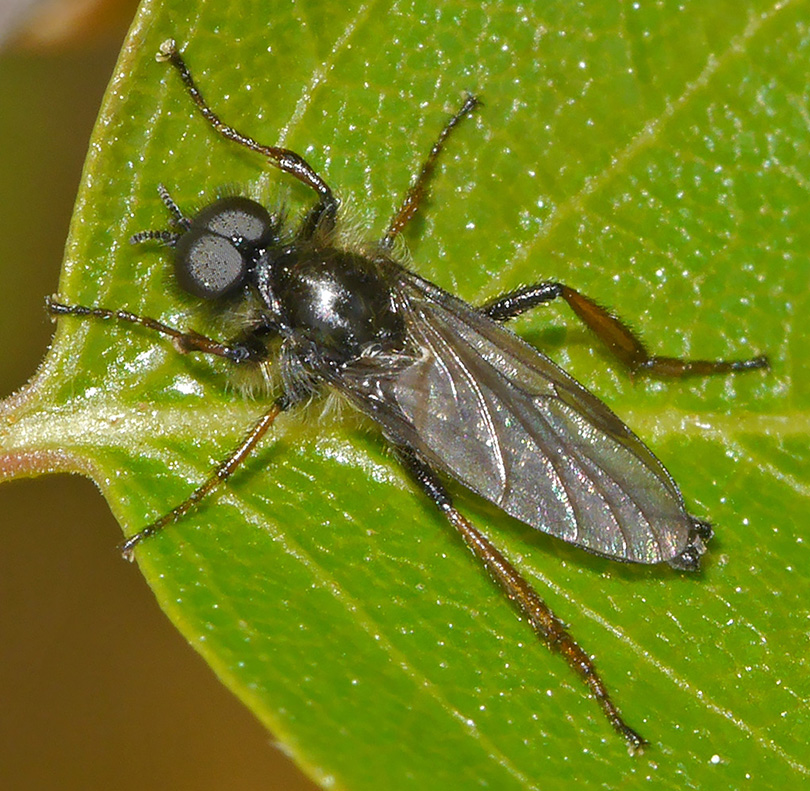
Where and when encountered: Grantown-on-Spey on 5 May 2026
About: Flies of the species Bibio lanigerus can be found in a variety of habitats – in various corners of Great Britain – but especially favour heathland, coastal dunes, and areas with light soils.
Years with at least one adult record: 2026 (1)
♀♂ St Mark's fly (Bibio marci)
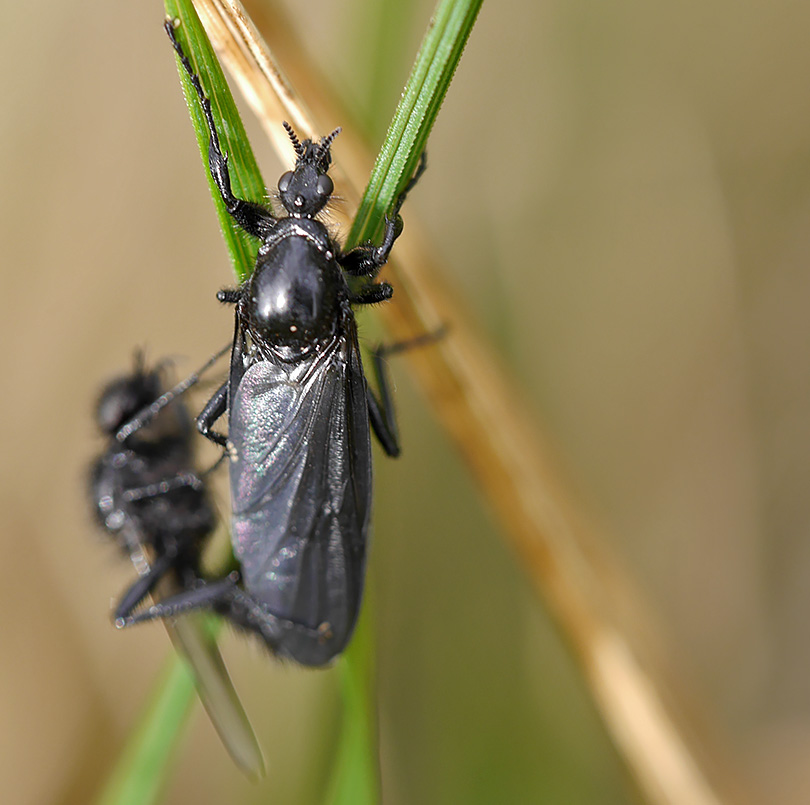
Where and when encountered: Grantown-on-Spey on 8 May 2026
About: St Mark's flies get their vernacular name as a phenological reference to their reliable emergence each year around St Mark?s Day (25 April). They may be encountered along woodland edges and hedges, as well as in wetland and rough-grassland habitat. The species can be found from the far north to the far south of Great Britain.
Date range for live (non-diapausing) adult records: 2 to 20 May (19 days)
Years with at least one adult record: 2026 (1)
♀ St Mark's fly (Bibio marci)
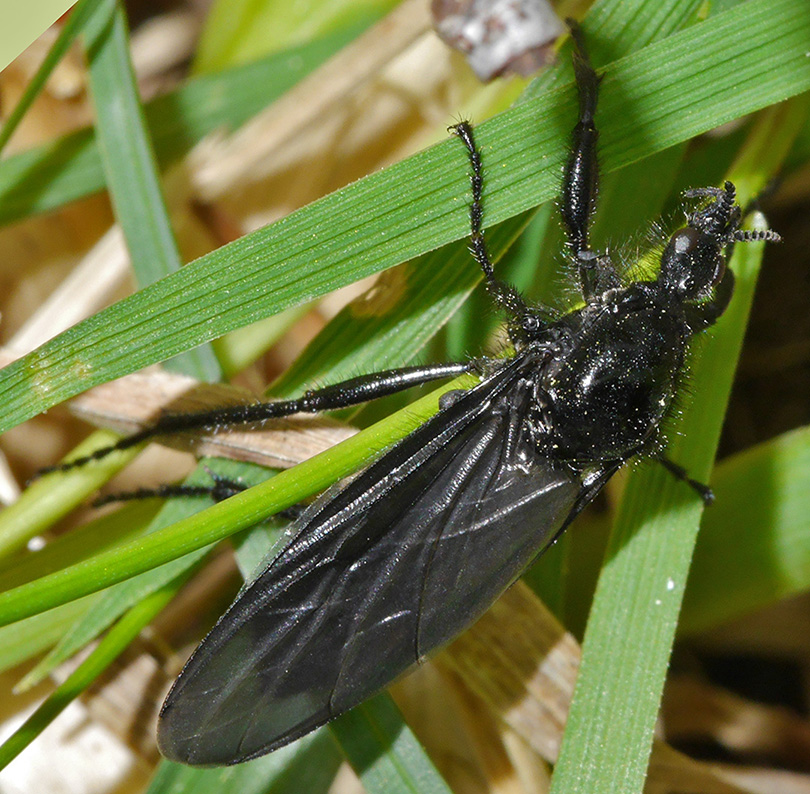
Where and when encountered: Grantown-on-Spey on 6 May 2026
About: St Mark's flies get their vernacular name as a phenological reference to their reliable emergence each year around St Mark?s Day (25 April). They may be encountered along woodland edges and hedges, as well as in wetland and rough-grassland habitat. The species can be found from the far north to the far south of Great Britain.
Date range for live (non-diapausing) adult records: 2 to 20 May (19 days)
Years with at least one adult record: 2026 (1)
♂ St Mark's fly (Bibio marci)
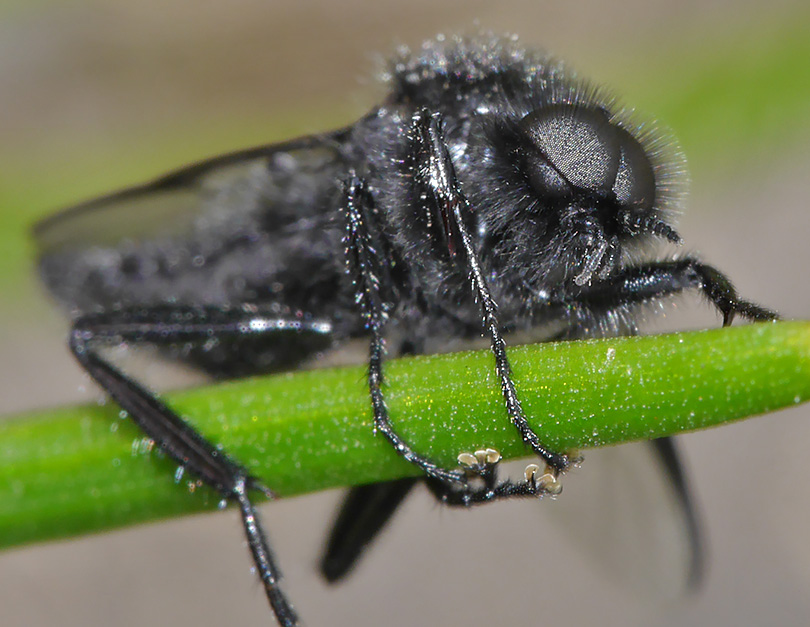
Where and when encountered: Grantown-on-Spey on 2 May 2026
About: St Mark's flies get their vernacular name as a phenological reference to their reliable emergence each year around St Mark?s Day (25 April). They may be encountered along woodland edges and hedges, as well as in wetland and rough-grassland habitat. The species can be found from the far north to the far south of Great Britain.
Date range for live (non-diapausing) adult records: 2 to 20 May (19 days)
Years with at least one adult record: 2026 (1)
♀ Red-thighed St Mark's fly (Bibio pomonae)
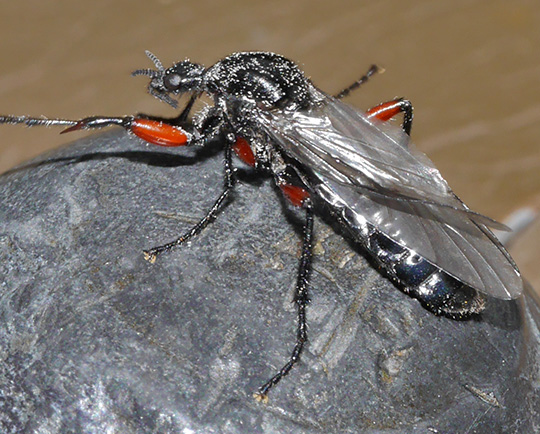
Where and when encountered: Nethy Bridge on 23 August 2025
About: Red-thighed St Mark's flies are associated, in particular, with open upland habitats, but they can be found from the far north to the far south of Great Britain.
Editor's note: The female of the species (as in the photograph) has much smaller eyes than the male.
Date range for live (non-diapausing) adult records: 22 to 23 August (2 days)
Years with at least one adult record: 2024, 2025 (2)
♂ Red-thighed St Mark's fly (Bibio pomonae)
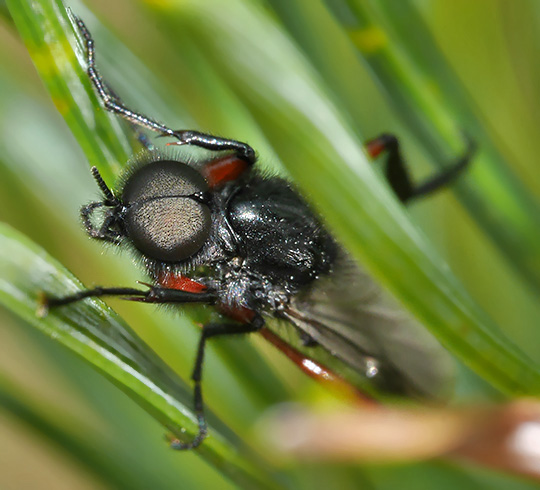
Where and when encountered: Foal's Well on 22 August 2024
About: Red-thighed St Mark's flies are associated, in particular, with open upland habitats, but they can be found from the far north to the far south of Great Britain.
Editor's note: The male of the species (as in the photograph) has much larger eyes than the female.
Date range for live (non-diapausing) adult records: 22 to 23 August (2 days)
Years with at least one adult record: 2024, 2025 (2)
Pine hoverfly (Blera fallax)
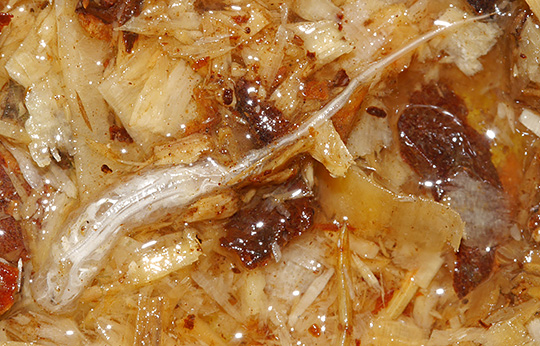
Where and when encountered: Cairngorms National Park on 13 August 2025
About: Pine hoverflies are critically endangered in Great Britain, where they are restricted to pine woodland in the Cairngorms. Their larvae develop in damp rot holes in Scots pine.
Editor's note: This photograph of a larva was taken inside a special conservation breeding facility that is working to aid the recovery of the species.
Grey-shouldered sap-eater (Brachyopa pilosa)
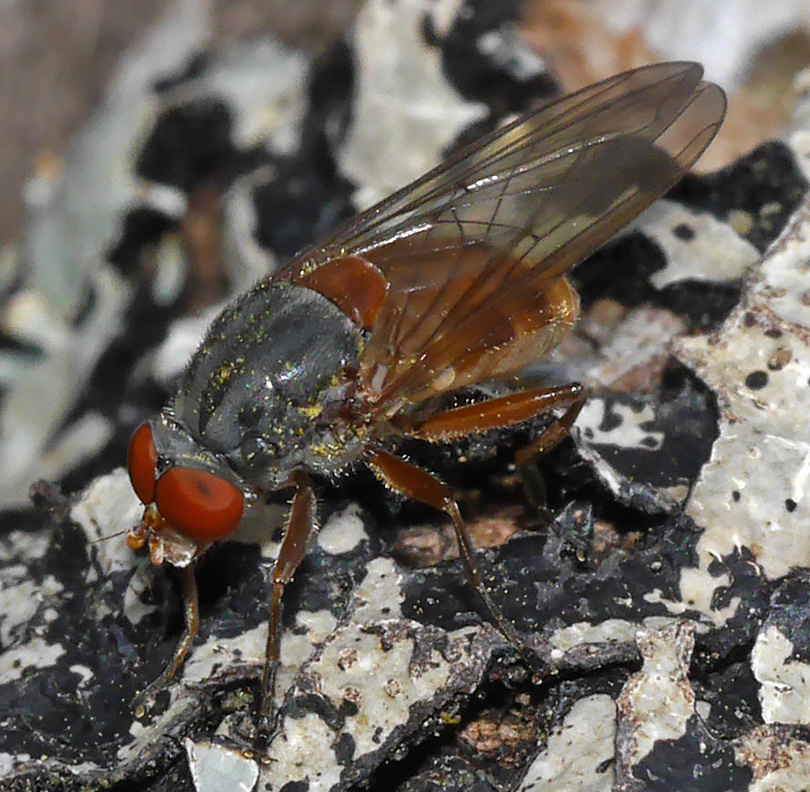
Where and when encountered: Grantown-on-Spey on 29 April 2026
About: Hoverflies of the species Brachyopa pilosa may be encountered in old woodland in the southern half of Britain (especially with newly fallen beech) and in the Scottish Highlands. In the latter case, they favour aspen woodland, and the larvae develop in the sap under the bark of recently fallen trees.
Date range for live (non-diapausing) adult records: 29 April to 24 May (26 days)
Years with at least one adult record: 2026 (1)
Foxy blacklet (Cheilosia chrysocoma)

Where and when encountered: Anagach Woods on 5 May 2025
About: Cheilosia chrysocoma is a nationally scarce species of hoverfly, with a very patchy distribution in Great Britain. These hoverflies may be encountered in damp woodland rides and clearings, in marshes, and in damp meadows, especially where wild angelica is well-established.
Years with at least one adult record: 2025 (1)
Bumblebee blacklet (Cheilosia illustrata)

Where and when encountered: Nethy Bridge on 13 May 2025
About: Hoverflies of the species Cheilosia illustrata can be found in most corners of Great Britain, although they are somewhat less commonly encountered in the far north than elsewhere. The larvae develop in the roots of hogweed and possibly several other umbellifers too.
Date range for live (non-diapausing) adult records: 5 to 24 May (20 days)
Years with at least one adult record: 2025, 2026 (2)
Broad centurion (Chloromyia formosa)
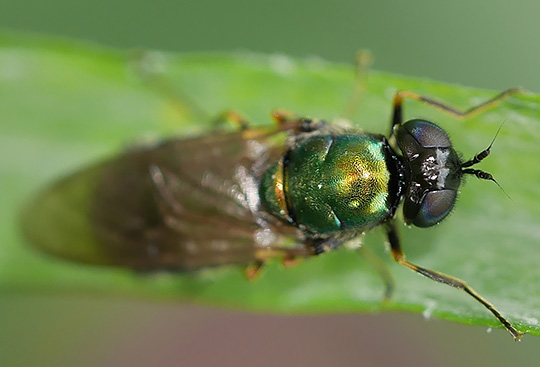
Where and when encountered: Grantown-on-Spey on 14 June 2024
About: Broad centurion soldier flies may be encountered in most parts of Great Britain, although they become rarer further north. Their larvae derive nourishment from decaying organic, while the adults feed from flowers, including hogweed.
Date range for live (non-diapausing) adult records: 13 to 14 June (2 days)
Years with at least one adult record: 2024 (1)
Northern spearhorn (Chrysotoxum arcuatum)

Where and when encountered: Abernethy Forest on 21 June 2024
About: Hoverflies of the species Chrysotoxum arcuatum have an upland distribution within Great Britain.
Years with at least one adult record: 2024 (1)
Two-banded spearhorn (Chrysotoxum bicinctum)
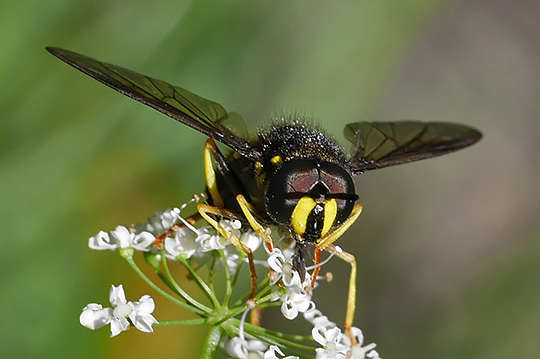
Where and when encountered: Craigellachie NNR on 27 June 2022
About: Hoverflies in this species favour open grassland and grassy woodland rides. They are widely distributed and relatively common in the south of Great Britain but less so in northern areas.
Years with at least one adult record: 2022 (1)
Four-banded bee-grabber (Conops quadrifasciatus)
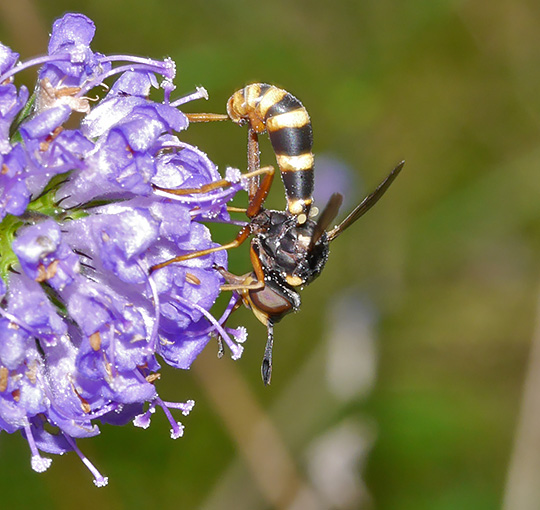
Where and when encountered: Craigellachie NNR on 19 August 2025
About: Conops quadrifasciatus is a species of Conopid fly with a distribution that covers most parts of Great Britain, although with an apparent gap from the far north of England into southern Scotland. The life-cycle of these flies relies on parasitizing bumblebees, and they may be encountered in flower-rich habitats including those where ragworts, scabiouses, and thistles are attracting their targets in abundance.
Years with at least one adult record: 2025 (1)
Single-striped Xanthempis (Empis stercorea)
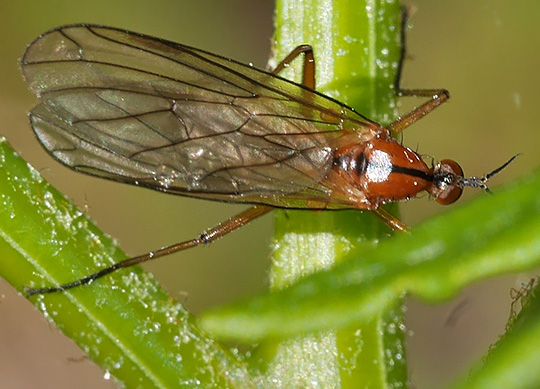
Where and when encountered: Grantown-on-Spey on 22 May 2025
About: Flies of the species Empis stercorea are typically encountered in lush habitats, including woodland edges, scrubby grassland, and field margins. They can be found in various corners of Great Britain.
Years with at least one adult record: 2025 (1)
Tessellated dance fly (Empis tessellata)
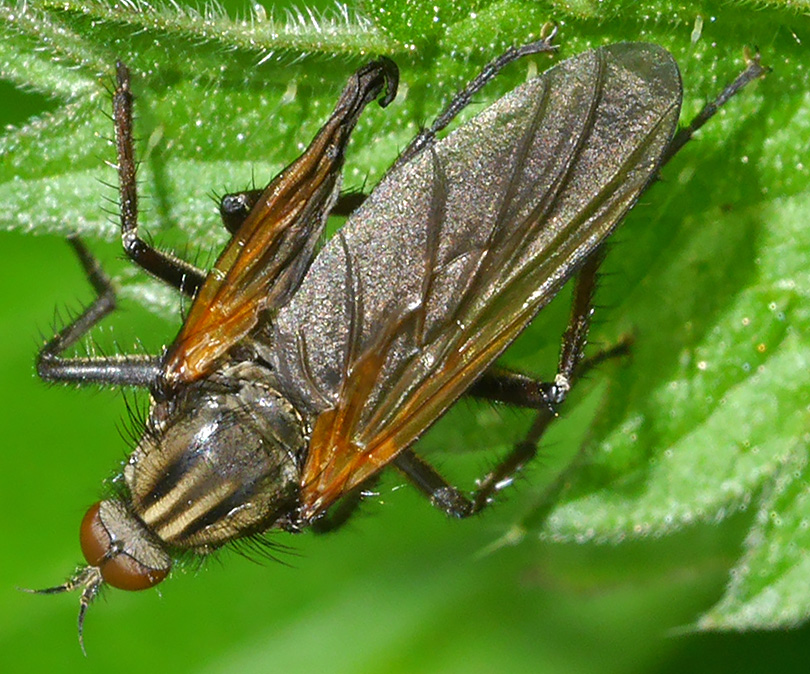
Where and when encountered: Speybridge on 21 May 2026
About: Dance flies of the species Empis tessellata live in a wide variety of habitats and can often be found as adults on the flowers of umbellifers. They may be encountered from the far north to the far south of Great Britain.
Date range for live (non-diapausing) adult records: 21 to 25 May (5 days)
Years with at least one adult record: 2026 (1)
Marmalade hoverfly (Episyrphus balteatus)
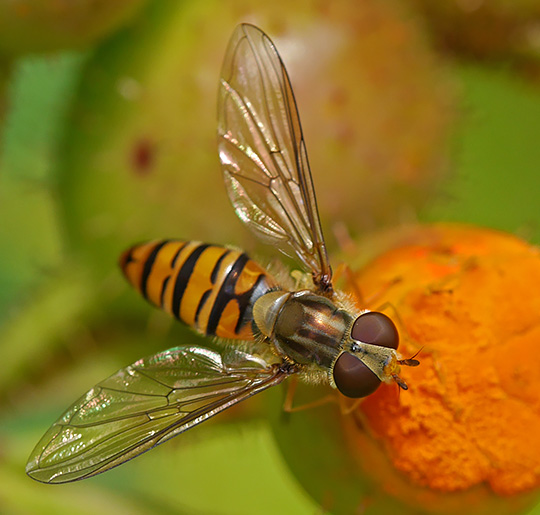
Where and when encountered: Grantown-on-Spey on 8 July 2025
About: These insects are instantly recognizable within Great Britain's hoverfly fauna from the two black 'moustaches' on their abdomen. The coloration of individuals within the species is indicative of the temperature at which the larvae developed: a greater amount of orange suggests warmer conditions, while more black indicates a cooler formative environment. The larvae feed on a wide range of aphids, including those that abound within agricultural crops. The species is common in many parts of Great Britain.
Date range for live (non-diapausing) adult records: 18 June to 24 September (99 days)
Years with at least one adult record: 2021, 2022, 2023, 2025 (4)
Tapered dronefly (Eristalis pertinax)

Where and when encountered: Carrbridge on 8 July 2022
About: Hoverflies in this species can be found throughout Great Britain in a wide range of habitats, from spring through to autumn.
Date range for live (non-diapausing) adult records: 18 May to 17 October (153 days)
Years with at least one adult record: 2021, 2022, 2024, 2025, 2026 (5)
Common dronefly (Eristalis tenax)

Where and when encountered: Glenbeg on 12 October 2025
About: Insects of this species can be found throughout Great Britain and are one of the most widespread hoverflies on the planet. They are unusual for hoverflies in overwintering as adults.
Years with at least one adult record: 2025 (1)
Common spotted field syrph (Eupeodes luniger)

Where and when encountered: Dulnain Bridge on 3 June 2022
About: Members of the species Eupeodes luniger can be found throughout most of Great Britain, although they are more frequently encountered south of Hadrian's Wall. They can be seen in most months of the year, with a peak in numbers occurring in late summer.
Date range for live (non-diapausing) adult records: 3 to 14 June (12 days)
Years with at least one adult record: 2022, 2024 (2)
Aspen hoverfly (Hammerschmidtia ferruginea)
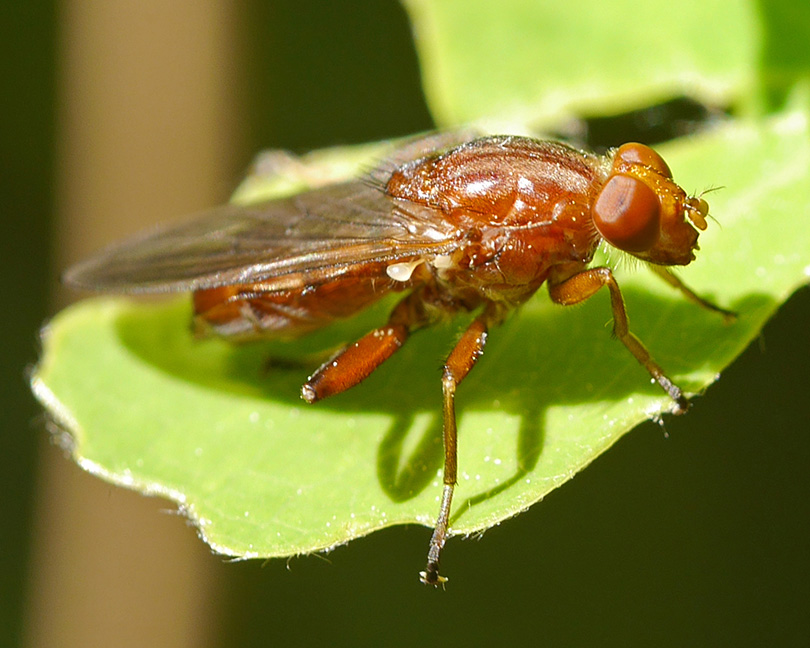
Where and when encountered: Grantown-on-Spey on 26 May 2026
About: Aspen hoverflies are dependent on fallen trunks and branches of the tree in their vernacular name, with larvae feeding on micro-organisms in the decaying sap found under the bark. In Great Britain, they are known only from the Scottish Highlands (with Strathspey representing the stronghold for their population).
Years with at least one adult record: 2026 (1)
Marsh tiger hoverfly (Helophilus hybridus)

Where and when encountered: Nethy Bridge on 24 June 2022
About: Hoverflies in this species favour wetland habitats, and they may be encountered in many corners of Great Britain, although their distribution is restricted in the far north.
Years with at least one adult record: 2022 (1)
The footballer (Helophilus pendulus)

Where and when encountered: Grantown-on-Spey on 14 June 2024
About: Known as the footballer, on account of the jersey-like vertically striped thorax (although this is not unique to this species of hoverfly), Helophilus pendulus may be encountered in the vicinity of ponds, muddy puddles, and wet ditches, as well in sunny spots away from water. The species is widespread across Great Britain.
Date range for live (non-diapausing) adult records: 16 May to 14 June (30 days)
Years with at least one adult record: 2024, 2026 (2)
Aspen wingwaver (Homalocephala biumbrata)
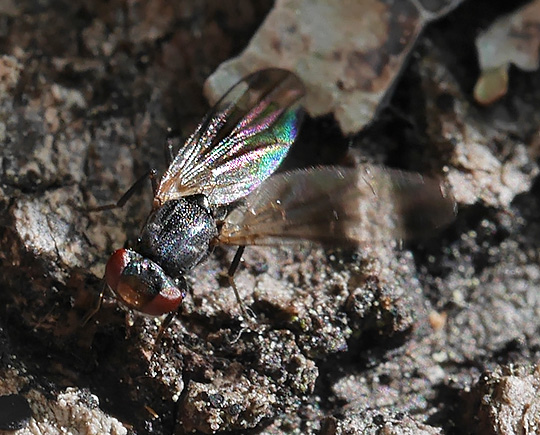
Where and when encountered: Grantown-on-Spey on 22 May 2025
About: Aspen wingwavers are rarely encountered insects restricted to the northern par of Great Britain and especially the Scottish Highlands. The vernacular name references their habit of waving their wings while walking over fallen aspen trunks and branches. Females have been recorded laying eggs into cracks in bark.
Date range for live (non-diapausing) adult records: 21 to 22 May (2 days)
Years with at least one adult record: 2025 (1)
Slender-horned horsefly (Hybomitra montana)

Where and when encountered: Abernethy Forest on 25 June 2025
About: Slender-horned horseflies are a species of northern and western Great Britain, for the most part. They are associated with damp habitats, including upland fens and bogs, as well as northern saltmarshes.
Years with at least one adult record: 2025 (1)
♀ Bumblebee robberfly (Laphria flava)
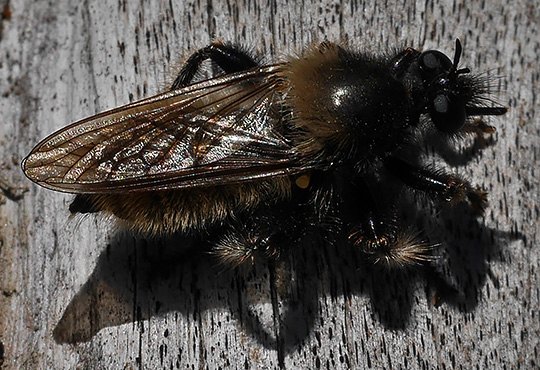
Where and when encountered: Glenbeg on 10 July 2022
About: Bumblebee robberflies are large predatory insects. Their larvae develop in decaying pine wood, where they predate longhorn beetle grubs. Ancient Caledonian pine forest in the Scottish Highlands, especially that in the Cairngorms, is the stronghold for the species. However, the distribution of the species appears to be expanding.
Date range for live (non-diapausing) adult records: 24 May to 10 July (48 days)
Years with at least one adult record: 2022, 2024, 2025 (3)
♂ Bumblebee robberfly (Laphria flava)

Where and when encountered: Grantown-on-Spey on 24 May 2025
About: Bumblebee robberflies are large predatory insects. Their larvae develop in decaying pine wood, where they predate longhorn beetle grubs. Ancient Caledonian pine forest in the Scottish Highlands, especially that in the Cairngorms, is the stronghold for the species. However, the distribution of the species appears to be expanding.
Date range for live (non-diapausing) adult records: 24 May to 10 July (48 days)
Years with at least one adult record: 2022, 2024, 2025 (3)
Pale-saddled Leucozona (Leucozona glaucia)

Where and when encountered: Grantown-on-Spey on 8 July 2025
About: Insects in this species can principally be found in the north and west of Great Britain, where they may be one of the most abundant hoverflies around the height of summer.
Date range for live (non-diapausing) adult records: 8 July to 5 September (60 days)
Years with at least one adult record: 2021, 2023, 2025 (3)
Dark-saddled Leucozona (Leucozona laternaria)

Where and when encountered: Boat of Garten on 30 June 2025
About: Hoverflies of the species Leucozona laternaria are typically encountered on umbellifers such as hogweed in woodland rides and clearings, especially within damper woods. They are fairly widespread in England and Wales but somewhat more sporadically distributed in Scotland.
Years with at least one adult record: 2025 (1)
Blotch-winged whitebelt (Leucozona lucorum)

Where and when encountered: Nethy Bridge on 7 June 2022
About: Hoverflies in this species can be found throughout Great Britain, with a peak in abundance around the middle of spring.
Date range for live (non-diapausing) adult records: 2 June to 16 August (76 days)
Years with at least one adult record: 2022, 2024, 2025 (3)
Northern small-palp (Linnaemya rossica)
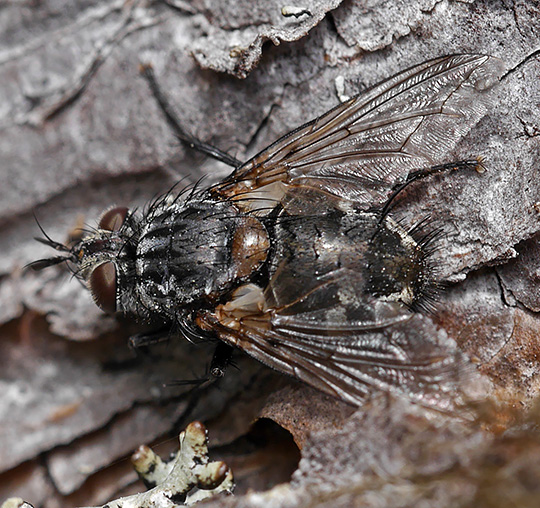
Where and when encountered: Garlyne Moss on 21 September 2025
About: True flies of the species Linnaemya rossica may be encountered along woodland edges and in woodland clearings, and, in Great Britain, they are primarily found in the Scottish Highlands.
Editor's note: I am somewhat confident of the species identification of this insect.
Years with at least one adult record: 2025 (1)
Heath small-palp (Linnaemya vulpina)
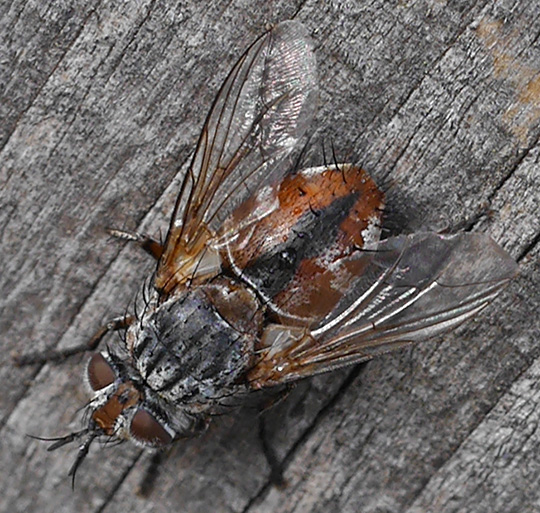
Where and when encountered: Garlyne Moss on 21 September 2025
About: True flies of the species Linnaemya vulpina are associated with heathland and moorland habitats, and they may be encountered from the far north to the far south of Great Britain.
Years with at least one adult record: 2025 (1)
♀ Spring spot-tail (Melangyna lasiophthalma)
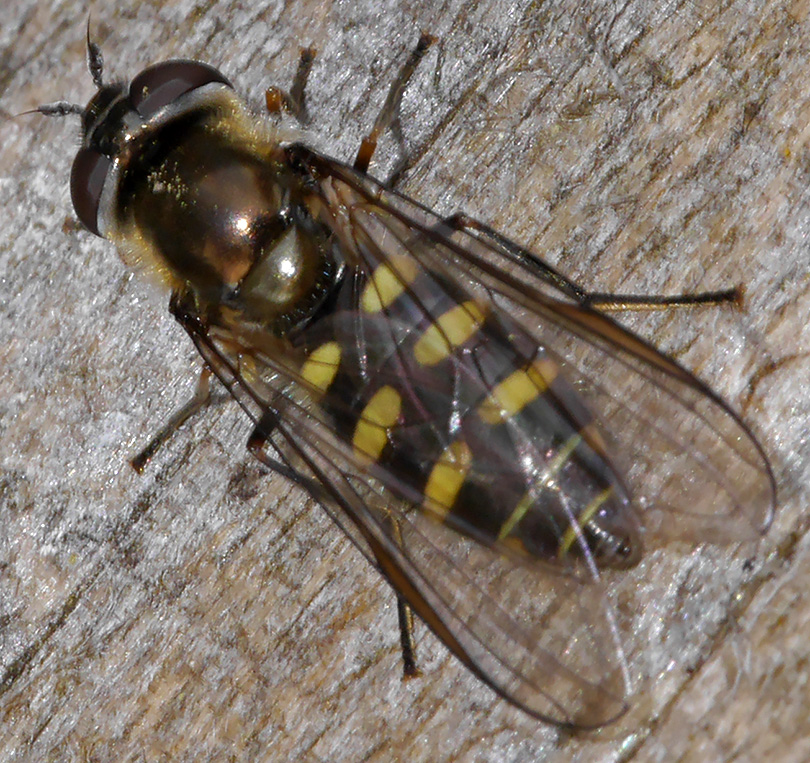
Where and when encountered: Grantown-on-Spey on 8 May 2026
About: Hoverflies of the species Melangyna lasiophthalma are insects of wooded areas. They may be encountered in various corners of Great Britain.
Years with at least one adult record: 2026 (1)
Chequered hoverfly (Melanostoma scalare)

Where and when encountered: Abernethy Forest on 7 July 2022
About: Chequered hoverflies can be seen flying in various corners of Great Britain from April to November.
Editor's note: The white powder on the wings and abdomen of this female is not pollen but a fungus, quite possibly the deadly Entomophthora muscae.
Date range for live (non-diapausing) adult records: 16 May to 4 June (20 days)
Years with at least one adult record: 2022, 2024, 2025, 2026 (4)
Banded Meliscaeva (Meliscaeva cinctella)

Where and when encountered: Grantown-on-Spey on 25 July 2024
About: Hoverflies of the species Meliscaeva cinctella can be found from the far north to the far south of Great Britain.
Date range for live (non-diapausing) adult records: 6 May to 24 September (142 days)
Years with at least one adult record: 2022, 2024, 2025, 2026 (4)
Noon fly (Mesembrina meridiana)
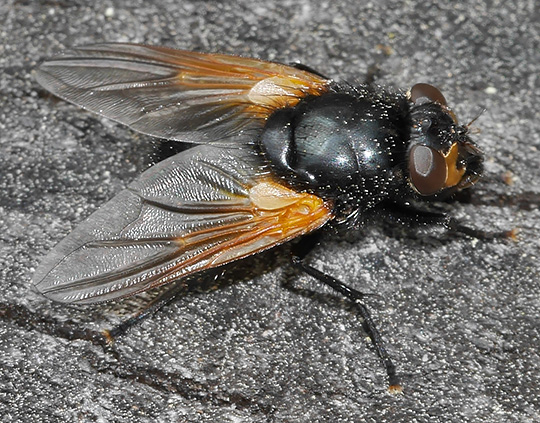
Where and when encountered: Rothiemurchus Estate on 18 May 2024
About: Noon flies may be encountered in most corners of Great Britain. Their larvae live in cow pats and horse excrement, feeding on other dung-inhabiting invertebrates.
Editor's note: Most sources do not discuss the meaning of the noon fly's vernacular name, but one account that I found supported the obvious interpretation: they can be seen around noon (among other times).
Date range for live (non-diapausing) adult records: 18 May to 23 August (98 days)
Years with at least one adult record: 2024, 2025, 2026 (3)
Batman hoverfly (Myathropa florea)

Where and when encountered: Carrbridge on 8 July 2022
About: Colloquially known as the 'Batman' hoverfly, on account of the distinct marking that can be seen on the thorax of many individuals in this species, this fly can be found from the far north to the far south of Great Britain, with a peak in numbers in mid-summer.
Date range for live (non-diapausing) adult records: 16 May to 8 July (54 days)
Years with at least one adult record: 2022, 2024 (2)
White-veined spring bee-grabber (Myopa buccata)
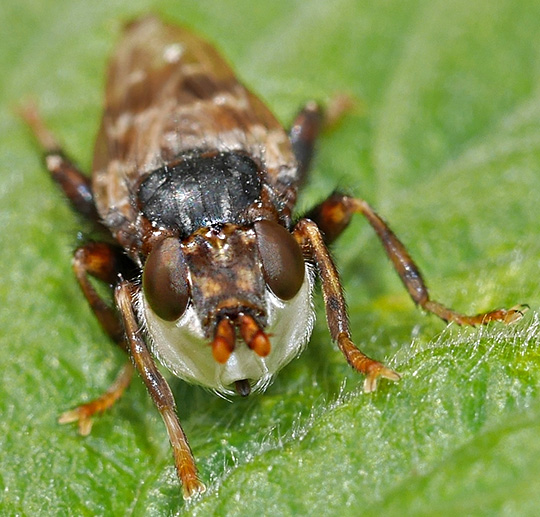
Where and when encountered: Grantown-on-Spey on 2 June 2025
About: Flies of the species Myopa buccata parasitize various species of bee in the genus Andrena and may be encountered around spring-blossoming shrubs such as blackthorn, hawthorns, and rowan, as well as other plants inlcuding blaeberry. They can be found in various corners of Great Britain and are the dominant member of the genus in northern Scotland.
Date range for live (non-diapausing) adult records: 16 May to 2 June (18 days)
Years with at least one adult record: 2025, 2026 (2)
♀ Common awl robberfly (Neoitamus cyanurus)
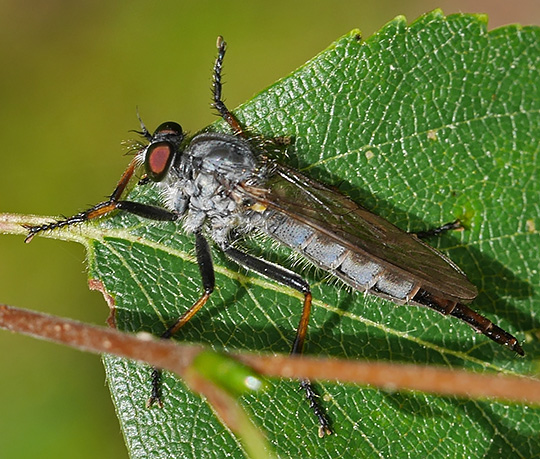
Where and when encountered: Anagach Woods on 10 August 2023
About: The 'awl' in the vernacular name of this robberfly species refers to the narrowed end of the abdomen possessed by females (like the individual in the photograph). This species has a strong association with woodland and can be found in various corners of Great Britain, although less commonly so in Scotland than to the south of Hadrian's Wall.
Date range for live (non-diapausing) adult records: 25 July to 10 August (17 days)
Years with at least one adult record: 2023, 2024 (2)
♂ Common awl robberfly (Neoitamus cyanurus)
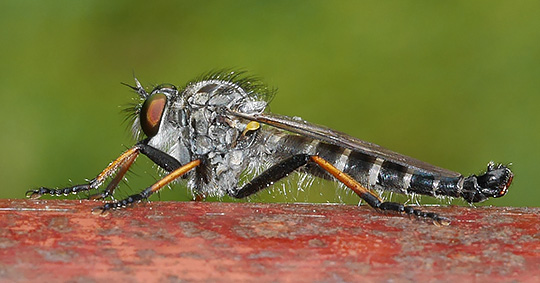
Where and when encountered: Grantown-on-Spey on 25 July 2024
About: The 'awl' in the vernacular name of this robberfly species refers to the narrowed end of the abdomen possessed by females (unlike the individual in the photograph). This species has a strong association with woodland and can be found in various corners of Great Britain, although less commonly so in Scotland than to the south of Hadrian's Wall.
Date range for live (non-diapausing) adult records: 25 July to 10 August (17 days)
Years with at least one adult record: 2023, 2024 (2)
Northern flutter fly (Palloptera usta)
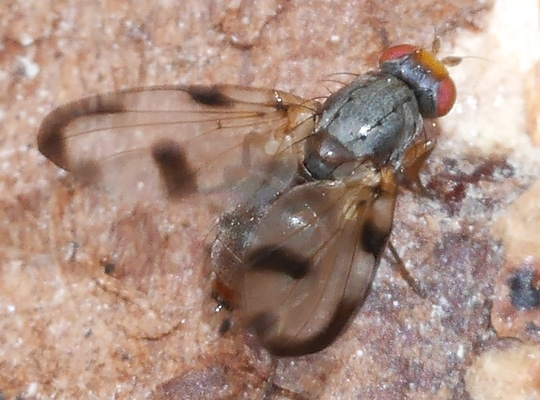
Where and when encountered: Abernethy Forest on 30 August 2024
About: Flutter flies of the species Palloptera usta are nationally scarce, and they are mainly found in the Scottish Highlands as opposed to elsewhere in Great Britain. They are an insect of woodlands, with larvae developing beneath the bark of fallen wood from pines and spruces, especially, but also from ash, birch, oak and some other broadleaved species as well.
Editor's note: The vernacular name for this insect's family – the flutter flies – relates to the wingwaving habit of many of the species.
Years with at least one adult record: 2024 (1)
Pedicia rivosa
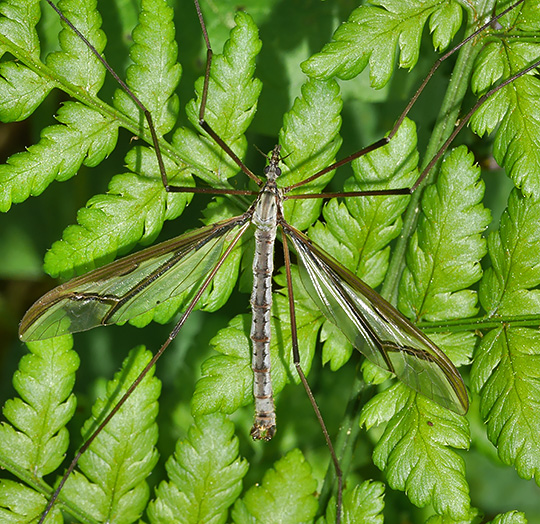
Where and when encountered: Dulnain Bridge on 17 May 2024
About: Craneflies in the species Pedicia rivosa can be found in marshy or other damp habitats from the far north to the far south of Great Britain.
Years with at least one adult record: 2024 (1)
♀ Northern robberfly (Rhadiurgus variabilis)
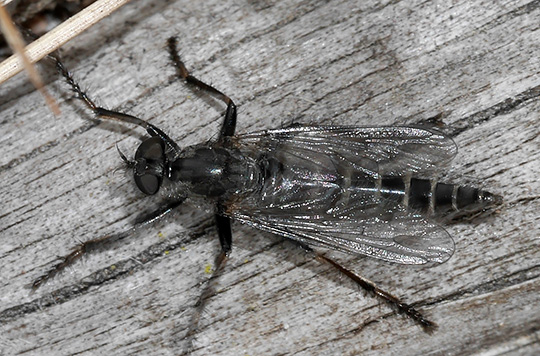
Where and when encountered: Garlyne Moss on 31 May 2025
About: In Great Britain, northern robberflies are most often found in the eastern part of the Scottish Highlands, especially the Cairngorms, and are considered nationally rare and vulnerable. They have a preference for sunny, sheltered areas of heather, especially in openings within Caledonian pine forest.
Years with at least one adult record: 2025 (1)
Downlooker snipefly (Rhagio scolopaceus)
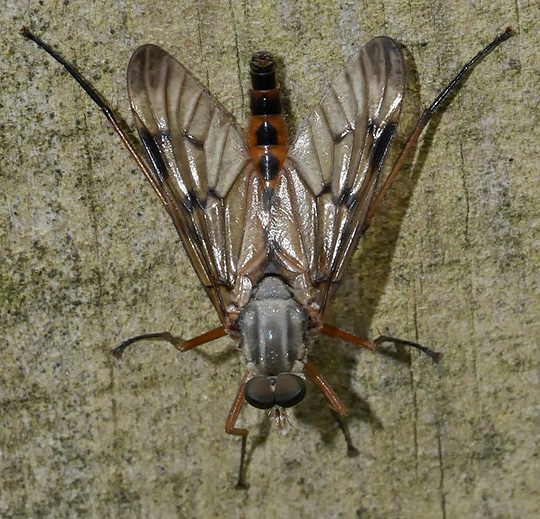
Where and when encountered: Speybridge on 25 May 2024
About: Downlooker snipeflies are predatory insects whose name references their habit of resting on fence-posts and in other suitable places with their face pointing to the ground, as they await passing prey. These snipeflies can be found in most parts of Great Britain.
Date range for live (non-diapausing) adult records: 21 May to 6 July (47 days)
Years with at least one adult record: 2024, 2025 (2)
Marsh snipefly (Rhagio tringarius)
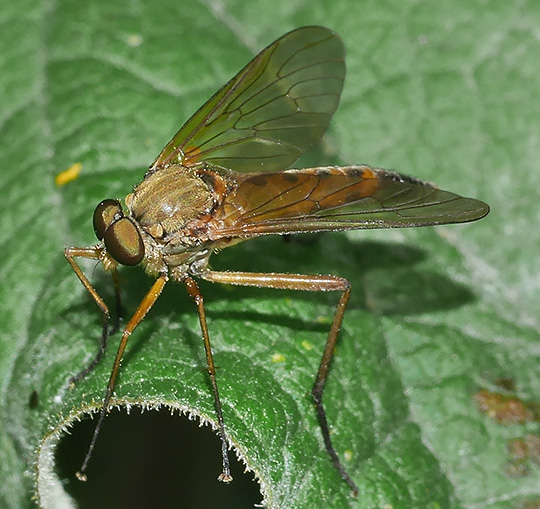
Where and when encountered: Castle Grant on 29 July 2024
About: Marsh snipeflies can be found in most corners of Great Britain but are more patchily distributed to the north. Their larvae are predatory, feeding on invertebrates such as earthworms and small beetles.
Years with at least one adult record: 2024 (1)
Common snout (Rhingia campestris)

Where and when encountered: Grantown-on-Spey on 6 May 2025
About: Hoverflies of the species Rhingia campestris can be found in most corners of Great Britain, although they are less commonly encountered in the far north than elsewhere. The long snout facilitates their foraging on tubulous flowers.
Date range for live (non-diapausing) adult records: 6 May to 30 August (117 days)
Years with at least one adult record: 2024, 2025, 2026 (3)
Pied hoverfly (Scaeva pyrastri)

Where and when encountered: Glenmore Forest Park on 9 September 2022
About: Pied hoverflies can be found in a range of habitats including gardens and meadows, across large parts of Great Britain. It is believed that successful overwintering is rare for this species in Great Britain, and so the population depends in large part on migration from mainland Europe.
Years with at least one adult record: 2022 (1)
Furcate dung fly (Scathophaga furcata)
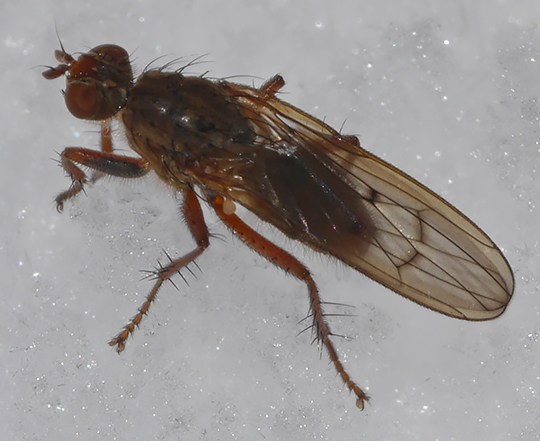
Where and when encountered: Nethy Bridge on 19 November 2025
About: Dung flies of the species Scathophaga furcata breed in dung of various sorts and can be found in a wide range of habitats from the far north to the far south of Great Britain.
Editor's note: This individual was standing on a thick layer of snow.
Years with at least one adult record: 2025 (1)
♂ Yellow dung fly (Scathophaga stercoraria)
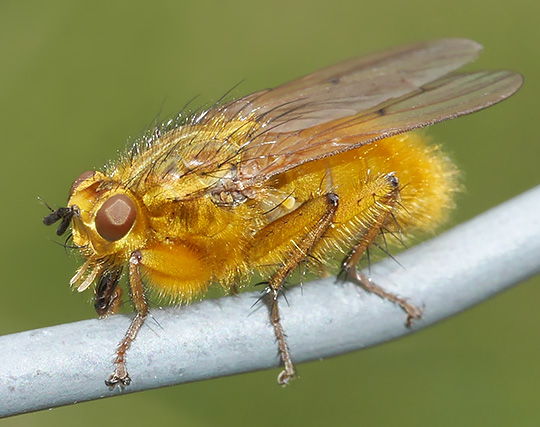
Where and when encountered: Speybridge on 28 April 2025
About: Yellow dung flies may be encountered in most corners of Great Britain. Adults feed mainly on small invertebrates, while the larvae develop in the dung of a wide range of mammals.
Date range for live (non-diapausing) adult records: 28 April to 25 August (120 days)
Years with at least one adult record: 2024, 2025 (2)
White-barred peat fly (Sericomyia lappona)

Where and when encountered: Grantown-on-Spey on 22 May 2025
About: This hoverfly species has a preference for boggy habitats and is most abundant in the north and west of Great Britain.
Date range for live (non-diapausing) adult records: 19 May to 22 June (35 days)
Years with at least one adult record: 2024, 2025 (2)
Yellow-barred peat fly (Sericomyia silentis)

Where and when encountered: Loch Vaa on 27 August 2021
About: This hoverfly species has a preference for habitats with acidic soil and is most abundant in the north and west of Great Britain. It has been suggested that adults tend to feed on flower-heads that are red or purple in colour.
Date range for live (non-diapausing) adult records: 9 June to 21 September (105 days)
Years with at least one adult record: 2021, 2022, 2024, 2025 (4)
Furry peat fly (Sericomyia superbiens)

Where and when encountered: Grantown-on-Spey on 12 August 2025
About: Hoverflies of the species Sericomyia superbiens are bumblebee mimics with an uplands-skewed distribution in Great Britain. They are most often encountered in the vicinity of damp peaty woodland.
Years with at least one adult record: 2025 (1)
Ferruginous bee-grabber (Sicus ferrugineus)
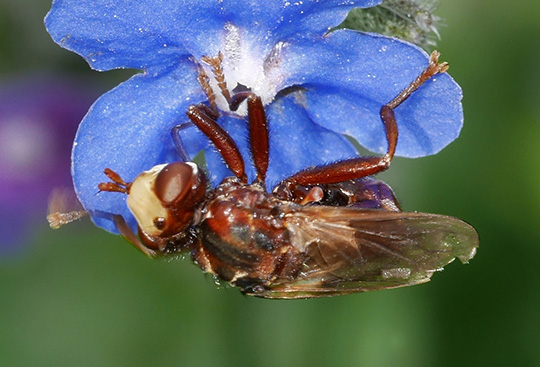
Where and when encountered: Milton Loch on 22 June 2024
About: Sicus ferrugineus is a species of Conopid fly with a distribution that covers various parts of Great Britain, including the Scottish Highlands. The life-cycle of this fly relies on the injection of an egg by females into the abdomen of a worker bumblebee.
Years with at least one adult record: 2024 (1)
Northern silver-stiletto (Spiriverpa lunulata)

Where and when encountered: Sluggan (Carrbridge) on 27 June 2024
About: The northern silver-stiletto is a fly associated with exposed sediment along sandy or stony watercourses. The majority of this species' Great British population is found in the Scottish Highlands, with Strathspey being a particularly important area, but the fly has also been found elsewhere in western and northern areas.
Years with at least one adult record: 2024 (1)
Bear Tachina (Tachina ursina)
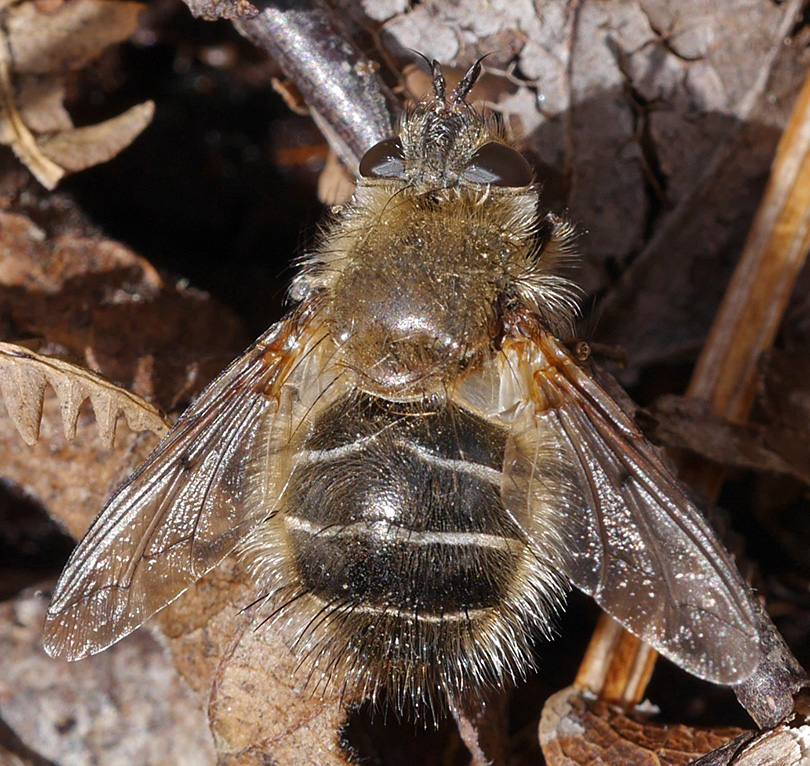
Where and when encountered: Grantown-on-Spey on 12 May 2026
About: This parasitoid (of unknown larval host) is a fly of woodland, heathland, and other open habitats. The species has a fondness for basking on sunlit dead leaves, including old bracken fronds, and can be found in various corners of Great Britain.
Date range for live (non-diapausing) adult records: 18 April to 12 May (25 days)
Years with at least one adult record: 2023, 2026 (2)
Tachypeza nubila
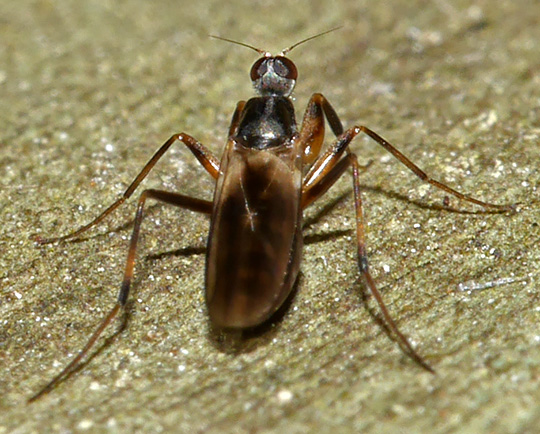
Where and when encountered: Garlyne Moss on 21 September 2025
About: True flies of the species Tachypeza nubila can typically be found on tree trunks, fence posts, and other wooden structures, and they may be encountered throughout much of Great Britain. They tend to run quickly away from threats, as opposed to flying.
Editor's note: I am somewhat confident of the species identification of the stonefly photographed.
Years with at least one adult record: 2025 (1)
Burdock Tephritis (Tephritis bardanae)
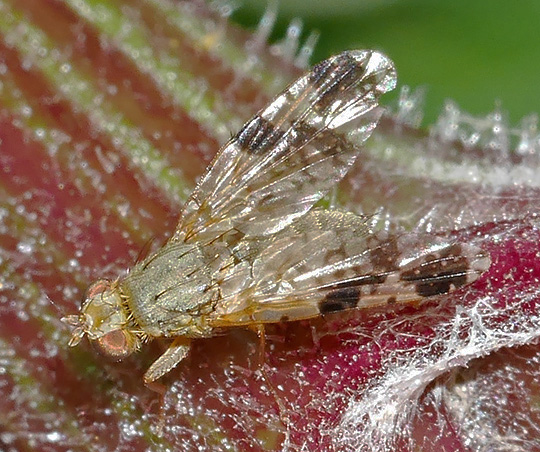
Where and when encountered: Castle Grant on 29 July 2024
About: Flies of the species Tephritis bardanae can be found in various corners of Great Britain but are less commonly encountered to the north. Larvae feed in burdock flower-heads, where they cause galls to form.
Years with at least one adult record: 2024 (1)
Tipula confusa
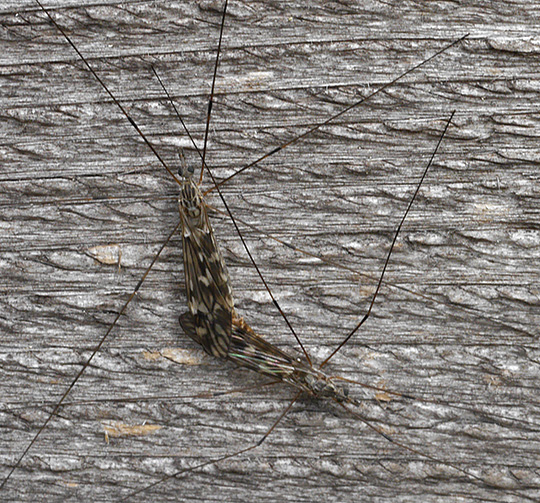
Where and when encountered: Garlyne Moss on 24 August 2025
About: Craneflies of the species Tipula confusa can be found in many corners of Great Britain. They may be encountered in or near woodlands and in gardens, and their larvae live in moss.
Editor's note: I am somewhat confident of the species identification of the stonefly photographed.
Years with at least one adult record: 2025 (1)
Tipula varipennis
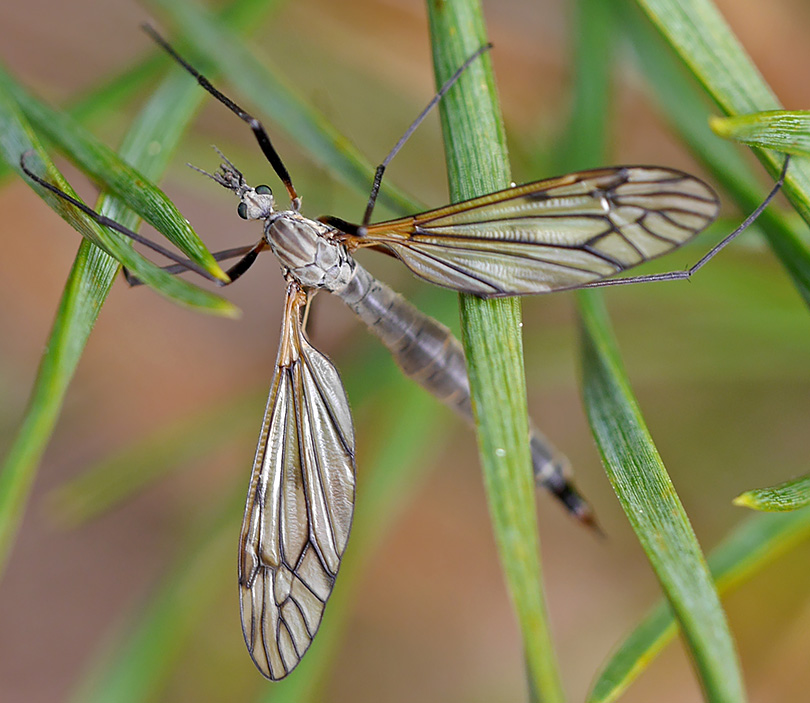
Where and when encountered: Duthil Plantation on 16 May 2026
About: Craneflies in the species Tipula varipennis can be found in, and on the edge, of woodland. They may be encountered in various corners of Great Britain but are less common towards the north of the country.
Years with at least one adult record: 2026 (1)
Tipula vittata
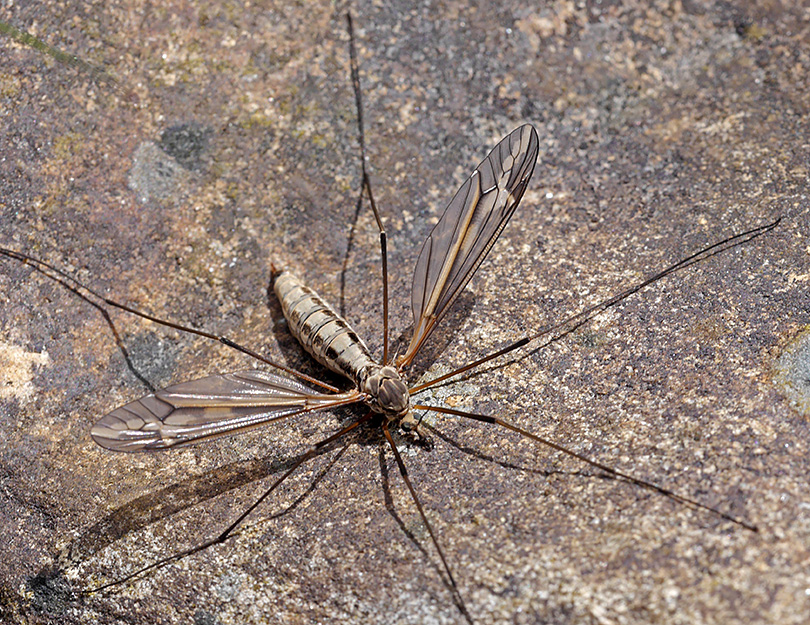
Where and when encountered: Glenfeshie on 11 May 2026
About: Craneflies in the species Tipula vittata can be found in wet woodlands and other moist habitats with lush vegetation, as well as along streamsides. They may be encountered in various corners of Great Britain but are less common towards the north of Scotland.
Years with at least one adult record: 2026 (1)
Great pied hoverfly (Volucella pellucens)

Where and when encountered: Carrbridge on 8 July 2022
About: Great pied hoverflies are widespread across Great Britain. Their larvae inhabit the nests of social wasps, where they scavenge among the debris.
Date range for live (non-diapausing) adult records: 17 June to 9 September (85 days)
Years with at least one adult record: 2021, 2022, 2025 (3)
Common awl-fly (Xylophagus ater)
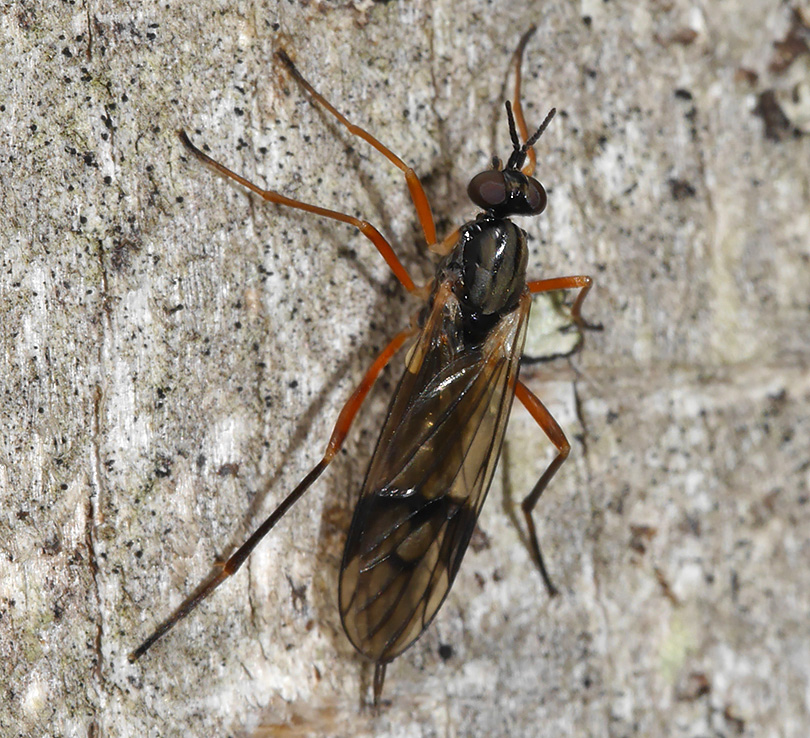
Where and when encountered: Grantown-on-Spey on 13 May 2026
About: This is an insect of old broadleaved woodland. Larvae develop beneath the bark and within the rotting heartwood of various trees, where they are thought to be predators. They are widespread in Great Britain although apparently absent from much of East Anglia.
Date range for live (non-diapausing) adult records: 13 to 15 May (3 days)
Years with at least one adult record: 2026 (1)
♂ Red-belted awl-fly (Xylophagus cinctus)
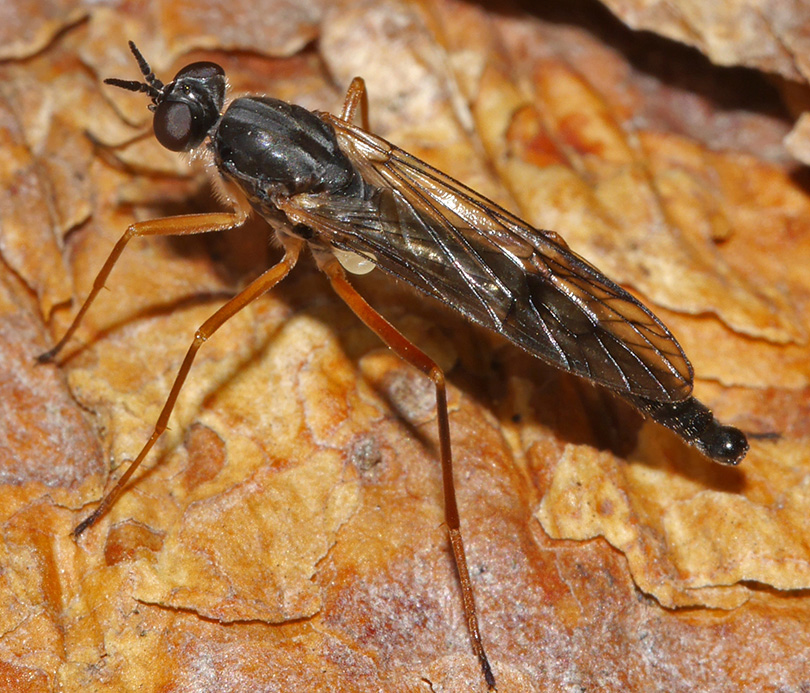
Where and when encountered: Anagach Woods on 21 May 2026
About: As larvae, red-belted awl-flies predate beetles under the bark of conifer stumps and recently fallen trunks and logs. The species is known especially from native pinewoods but is also associated with mature conifer plantations (pine or spruce). The large majority of records on NBN Atlas for this species are from the Cairngorms.
Date range for live (non-diapausing) adult records: 21 to 22 May (2 days)
Years with at least one adult record: 2026 (1)
Selected galleries
[ALL-TIME HIGHLIGHTS] [ARCTIC ALPINE PLANTS] [BUMBLEBEES] [BUTTERFLIES] [COLOURFUL MOTHS] [DRAGONFLIES] [FORBS] [GALLS] [GRASSLAND ORCHIDS] [INSECTS OF EXPOSED RIVER SEDIMENT] [LONGHORN BEETLES] [PINE-ASSOCIATED FUNGI] [PLANT BUGS] [SAWFLIES (ADULTS)] [SHIELDBUGS] [SOCIAL WASPS] [TRUE FLIES: AWL-FLIES] [TRUE FLIES: CRANEFLIES] [TRUE FLIES: DUNG FLIES] [TRUE FLIES: HOVERFLIES] [TRUE FLIES: MARCH FLIES] [TRUE FLIES: ROBBERFLIES] [TRUE FLIES: SNIPEFLIES] [TRUE FLIES: TACHINID FLIES] [TRUE FLIES: THICK-HEADED FLIES] [UNCOMMON PINEWOOD HERBS] [WOODY PLANTS]